Monday, April 16, 2012

Some Valley Growers Are Willing to Roll the Dice

Sometimes, it seems some farmers have a little gambling streak in them. They like to roll the dice and beat the house – or around here in farm country, Mother Nature.

With the unsettled weather lately, I’ve seen some growers willing to pick up the dice and bet their lucky numbers will come up and yield a nice financial payoff.
Ready for cotton planting.

In one cotton field in Dos Palos, for instance, I’ve seen one grower bet his early cotton planting will pay off in the late fall. Usually, pima varieties are planted earlier than acala because they take longer to mature and, thus, are the last cotton to be harvest. Most growers are holding off. In fact, this cooler weather has some growers considering a switch from planting pima to acala. Right now, that’s the back-up plan.

But there’s still enough time for soil temperatures to reach the threshold for planting. Growers can wait a couple more weeks until around April 25 – to get the pima seeds into the ground.

Overall, cotton growers are pretty much finished preparing their beds. Now it has become a waiting game for planting to start.

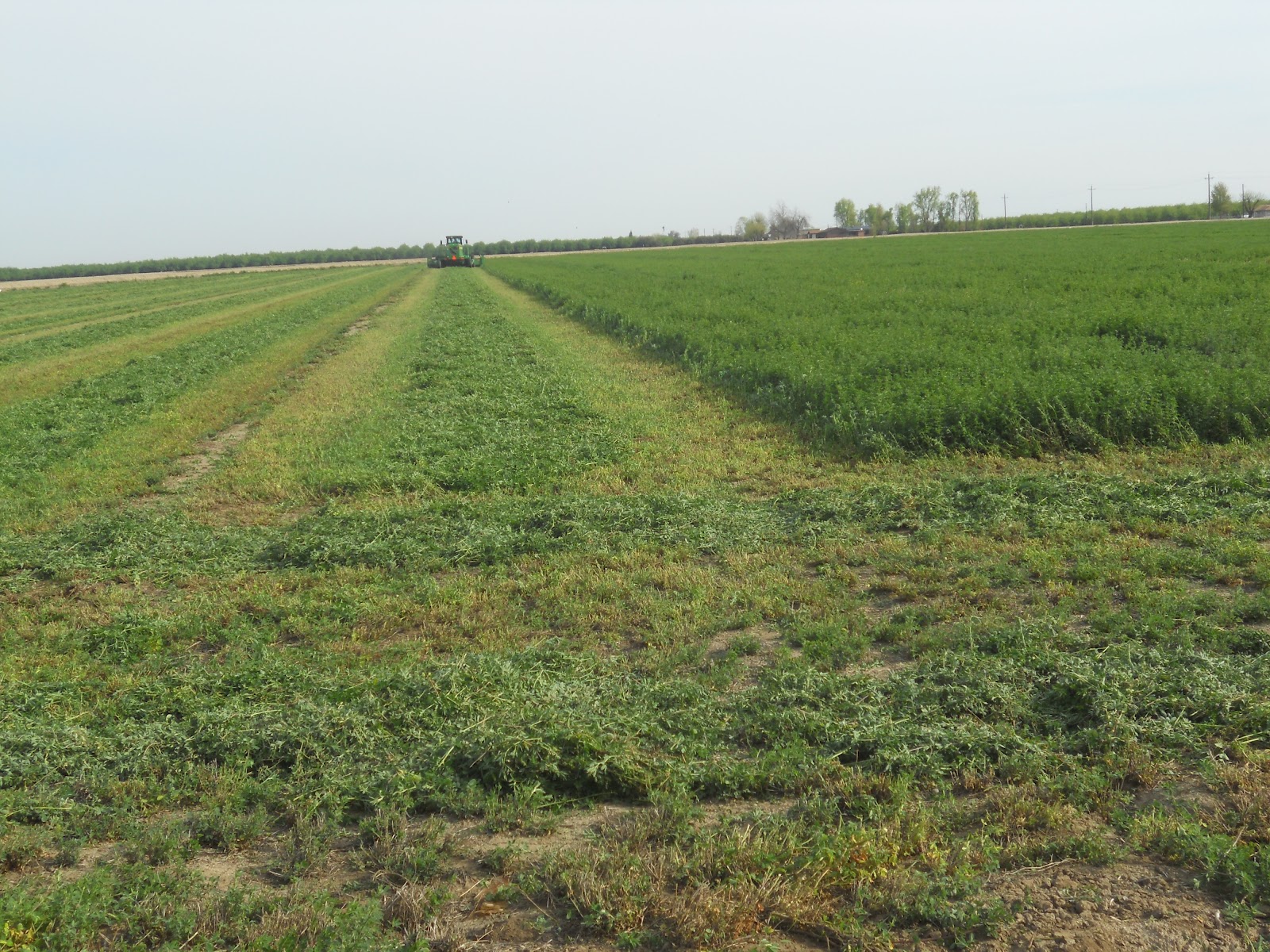
Cut alfalfa needed to be turned.
There’s a little game of chance going with alfalfa, as well. I’ve seen some growers bale their cut alfalfa a little early, opting to gamble on getting greenbacks now with a lower-quality, greener bale of alfalfa. Normally, newly cut alfalfa needs about eight to 10 days on the ground to dry. But those that cut the alfalfa about a week ago wound up having their harvested crop rained upon. They are betting on (and hoping for)  sunnier, warmer days this week to dry out their alfalfa.

Good bugs for alfalfa pests:
collops beetles and lady bugs.
On the bug front, I’ve been finding an increase in beneficial insects during my scouting rounds in the alfalfa fields. During my field sweeps, I’ve been finding lady bugs, minute pirates, collops beetles and assassin bugs – a natural predators to alfalfa pests. That’s a good sign. UC Integrated Pest Management offers a list of natural enemies and their common prey in alfalfa.  I am still seeing a lot of aphids around. Alfalfa weevils are down due to the alfalfa cutting. Meanwhile, I’ve been spotting some moths flying around. Growers need to keep an eye out for them.

Last Call for the Almond Field Day: Don’t forget to come to our first Almond Field Day of the season. It will be from 10 a.m. to noon on Thursday at the corner of Mercey Springs and Cotton Gin roads near Los Banos. The Almond Doctor, aka  pomologist David Doll of the UC Cooperative Extension in Merced County, and long-time entomologist Walt Bentley of UC IPM will share their expertise as they discuss the fruit development period. We’ll meet at an almond orchard at the corner of Mercy Springs and Cotton Gin roads in Los Banos. Look for the field day signs. You can also find directions at the Sustainable Cotton Project’s events website. Tell your friends and I will see you there.

Monday, April 9, 2012

Springtime Weather Creates Pesky Pest Concerns in Alfalfa


 There’s something bugging me and alfalfa growers lately.

As I scout the lush, green alfalfa fields across the Valley, I’ve been coming across some worrisome signs: plenty of crop-damaging pests.

Lady bugs will be a farmer's best friend this season when
 it comes  to helping them control crop-damaging pests.
As I mentioned last week, the weather conditions are perfect for alfalfa weevils to flourish and nibbling away at the alfalfa. These bugs seem to be out of control. Right now, the early spring cutting, or harvest, has been able control the weevils. Treatments, however, appear to be short-lived.

There’s more on the pest front. Aphids are becoming a concern. This is the earliest I’ve seen a heavy amount of aphids in alfalfa in the past five or six years. Mites are quite evident as well. Growers need to keep their eyes open for any signs of heavy aphid pressure.

Growers are turning their freshly cut alfalfa to get them to dry.
Another pest I’m seeing in the alfalfa fields is lygus. Usually I see lygus showing up around mid-May. Alfalfa growers need to be aware of their surroundings to prevent these pests from migrating to neighboring crops such as cotton. When tackling these pests, growers should remember the importance of chemical rotation.

 With rainy weather remaining a threat at the moment, alfalfa growers are trying to dry their freshly cut crop. Currently, growers are turning over their freshly cut alfalfa lying on the ground to dry.  The wet side, or bottom,  is flipped over to face the sun and dry before baling.

Cotton beds are ready for planting.
In the cotton fields, some growers are getting a jump on planting their seeds. Some were out planting Friday and Saturday so the seeds can germinate by Tuesday because of a threat of rain locally on Wednesday and Friday. Grower beware: planting early before soil temperatures are warm enough or in poorly drained beds can increase seedling root rots. Activity, though, is definitely picking up as growers aim to finish planting by the end of April. For now, most cotton growers are playing a waiting game with Mother Nature, waiting to spring into action.

Field Day Coming Up: Here’s another reminder about our first Almond Field Day of the year. It will be from 10 a.m. to noon on Thursday, April 19 in Los Banos. The Almond Doctor, aka  pomologist David Doll of the UC Cooperative Extension in Merced County, and long-time entomologist Walt Bentley of UC IPM will share their expertise as they discuss the fruit development period. We’ll meet at an almond orchard at the corner of Mercy Springs and Cotton Gin roads in Los Banos. Look for the field day signs. You can also find directions at the Sustainable Cotton Project’s events website. Bring a neighbor.


Monday, April 2, 2012

It's the Calm Before the Storm


Once again, Mother Nature is playing a starring role around the Valley.

Rainy weather continues to lead to starts and stops for farmers trying to get ready for this year’s growing season. In the past week, we had anywhere from a quarter inch to a half inch of rain with another two-tenths over the weekend. April showers are expected again this week.

These early spring storms are putting a damper on growers working the cotton beds and dealing with weeds as they to prepare for planting later this month.

I liken this to the calm before the storm of farm activity that will in full swing in the coming weeks. For now, the National Weather Service channel is certainly one of the most popular radio stations for farmers.
Indeed, we need soil temperatures to warm up before the first cotton seeds can be planted. Once again, the local NOAA Weather Service provides a critical role in forecasting five-day temperature forecasts.

UC Cooperative Extension and the UC IPM Program have been providing cotton planting forecasts to cotton growers and PCAs for over 20 years. This system is now available for the 2012 season. This forecast, with the planting guidelines, should be used in conjunction with soil temperatures (at seed depth) above 58 F at 8 a.m. for timely, vigorous seedling establishment. Remember, it is the soil temperature at planting depth which might require moving some soil if your planting beds have not been shaped. Since March 1, five-day forecasted temperatures have been less than 12 dd >60 degrees, which is in the unfavorable and marginal planting categories.

A parasitic wasp helps control weevils.
- UC IPM photo by Jack Kelly Clark
The recent weather is certainly affecting the alfalfa crop. Our mild temperatures – as Goldilocks would say neither “too hot” nor “too cold” – creates ideal conditions for alfalfa weevils. There have been some reports of poor control, which may related to application, environmental conditions or more troubling, increased tolerance. 

As a result, there may be the temptation to use materials such as Lorsban. My suggestion is to avoid organophosphates (OP). Using OPs may be effective for a few days, but they can open a Pandora’s Box. You don’t want to wipe out the natural enemies to alfalfa pests.

These are alfalfa weevil larvae I found.
Here’s a good example. During my field scouting, I’ve found quite a few aphids in some alfalfa fields. So far, parasitic wasps have been able to keep aphids under control.  If you used broad spectrum materials, you would wipe out the good bugs as well and end up with more pest management headaches down the line. For more information, you can refer to UC’s Year-Round IPM program for alfalfa.

Here's damage from alfalfa weevils.
On the harvest front, I saw a farmer already doing his first alfalfa cutting of the season. Despite the rainy weather, he was probably getting a jump on his first harvest to take advantage of the good alfalfa commodity prices. But that move could be costly if we get more wet weather and mold develops in his crop.

Most alfalfa growers are waiting the weather out.  I see a lot of real tall alfalfa out there. It usually takes a good 10 days to for the alfalfa to be dry enough for harvest. For now, growers are weathering the storms and getting as much work in as they can.

Field Day Alert: Don’t miss our first Almond Field Day of the year. It will be from 10 a.m. to noon on Thursday, April 19 in Los Banos.  The Almond Doctor, also known as pomologist David Doll of the UC Cooperative Extension in Merced County, and veteran entomologist Walt Bentley of UC IPM will share their expertise as they discuss the fruit development period. We’ll meet at an almond orchard at the corner of Mercy Springs and Cotton Gin roads in Los Banos. Look for the field day signs. You can also find directions at the Sustainable Cotton Project’s events website. Tell a friend.


Monday, March 19, 2012

Winter Gives Way to Spring: Let the 2012 Growing Season Begin

Winter sure is going out with a storm. This past weekend’s storms brought up to 1.5 inches of rain in Fresno and more than a half-inch in Firebaugh. Still, no one is declaring a March Miracle, especially for farmers.
With spring arriving Tuesday, we now can look forward with what I consider the start of the 2012 growing season. Ag activity around the Valley certainly is picking up.
The alfalfa crop is growing nicely.

Alfalfa growers are adding nitrogen and nutrients to give their crop one final boost before the first harvest. Herbicide and pesticide applications have taken place. Growers are treating for alfalfa weevils and a light amount of aphids found in various areas. From what I have seen so far, pest pressure is normal for this time of year. I expect the first cutting for alfalfa to occur in about two to three weeks. The crop is coming along quite nicely.

Beehives are moving out of the orchards.
In the almond orchards, the bees are finished buzzing around doing their important pollination chore for the season. Beekeepers are removing hives from the orchards and heading off for their next job. Most trees escaped damage from the frost that hit our area a few weeks ago. Overall, I’m seeing almond trees with a nice crop set this season. That bodes well for a good producing year. But let’s not get ahead of ourselves. There’s still months to go before harvest time.

Right now, almond growers are treating for mites and diseases, especially for shot hole, a fungus that survives in infected twigs and as spores on healthy buds, according to the University of California Statewide Integrated Pest Management website. Because of the relatively mild and dry winter, growers are seeing early signs of mites. Check out UC IPM for more information about mites.

Cotton growers have completed pre-irrigating their fields.
The last of the cotton growers – those with sandy soil – have wrapped up pre-irrigation of their fields. Those with clay and loam soils are starting to work their field beds. Cotton seeds are arriving. Expect the rebound in cotton acreage the past couple of years to end this year, thanks to soft global commodity prices and a drop in federal water allocations in the Westside. Many growers will put more emphasis on other crops such as almonds. But that’s farming for you.
 
For me, spring means spending more time in the field. This week, I’ll start my weekly field scouting with alfalfa. I’ll be sending out reports to growers participating in the San Joaquin Sustainable Farming Project. Give me a shout if you see me driving around.


Monday, March 5, 2012

Ready to Spring Forward with This Year's Growing Season

Valley almond orchards are showing their brilliant colors.

With daylight lasting longer every day, activity is picking up in the fields and orchards across the San Joaquin Valley. I expect it to get a lot busier next week as we spring forward with Daylight Savings Time coming up this weekend. Longer, sunlit days certainly signal another growing season is upon us.

Cotton growers pre-irrigating their fields.
Cotton growers are continuing to pre-irrigate their fields in preparation of the spring planting. Those with sandy soil are just starting pre-irrigation.

Around the orchards, there is a sea of white and pale pink lighting up the landscape. Trees are in full bloom – a spectacular sight and wonderful Kodak moment for photo buffs. Small leaves are already developing on the trees.

Impact of shot hole fungus.
UC IPM photo/Jack Kelly Clark
While there was steady snow falling in the mountains, the late-winter storm didn’t produce much rain on the Valley floor. We had anywhere from a 1/10th to 1/20th of an inch of rain. Still to guard against disease and what rain we had, a lot of growers are applying their second bloom spray. That will prevent brown rot blossom blight and shot hole fungus from developing. Thanks to the warm weather, bees have been active pollinating the almond trees.

 You can see the visible signs of  brown rot blossom blight.
                                                 UC IPM photo/Jack Kelly Clark
The alfalfa crop is growing nicely. I anticipate the first cutting to take place in about three weeks – a little earlier than the usual because of the mild winter. Growers are now treating for alfalfa weevils as well as weeds. Some are combining treatments with one application to save on labor costs. Growers should keep in mind that it’s a good practice to rotate their chemicals to avoid long-term pesticide resistance.

Growers are treating for alfalfa weevils.
If you want to learn more about pest management guidelines for alfalfa weevils, the University of California Statewide Integrated Pest Management (UC IPM) program offers a wealth of information through its website. UC IPM also offers tips about weed management for alfalfa.

Water update: Despite last week’s heavy dusting of snow in the Sierra Nevada, the water outlook remains iffy for Valley growers, especially those in the Westlands Water District. The Bureau of Reclamation announced an initial forecast of 30 percent water allocation. Westlands General Manager Thomas Birmingham called the announcement both “disappointing” given the near-record amount of water stored in reservoirs and “outstanding” in light of the dry conditions this winter. That is prompting some growers to cut back on their cotton planting this year and opt for other crops such as tomatoes. I’m sure we haven’t heard the rest of this story. To be continued…


Monday, February 20, 2012

Looks Like Spring in the Valley, But Calendar Says It's Winter


Almond trees are coming in bloom in many Valley areas.
 It’s hard to believe spring is still a month away. As I drive around farm country in the Great Valley, I’m seeing a lot of almond trees in colorful bloom and alfalfa fields shimmering in green.

Almond growers that didn’t apply dormant sprays like copper and oil are seeing 60 to 80 percent bloom in their trees. Dormant sprays will delay bloom. Let’s hope our area isn’t hit with heavy frost or heavy winter storms, which could cause problems with these early blooming trees. That could lead to blossom rot.

Alfalfa is looking good and is long past its winter dormant stage. Farmers will let the alfalfa grow until the first cutting, which usually takes place in mid or late April.

Here's a map of the Westlands Water District.
Water officials and cotton growers are certainly checking the weather forecasts regularly and looking toward the skies for signs of more rain in the Valley and snow in the Sierra Nevadas. Rain is nature’s version of pre-irrigation.

Heard on the Farms: Growers in the Westlands Water District received some bad news last week. They won’t be able to transfer the rest of their current water allocation into next season. Since they don’t need the water right now, many farmers are letting other growers have their water to irrigate their winter crops.

 About half our growers in our San Joaquin Sustainable Farming Project are in the Westlands district, which covers 600,000 acres of farmland south of Firebaugh (see the district map). Westlands growers have been anticipating a 35 to 50 percent water allocation this season. On Tuesday, the district will have its regular board meeting and I’m sure there will be an update about water availability for 2012. Stay tuned.


If water supplies becomes tight, some
growers may plant tomatoes over cotton.
In the past couple of years, cotton acreage has been on the upswing with increased water supplies and good commodity prices. Growers had talked about planting more cotton this year. But now, we may see less cotton acreage because of the water issue. Some growers will have to go to Plan B and plant less thirsty crops such as tomatoes using drip irrigation systems to conserve and maximize their water supplies. There’s no need to panic yet. There is still time before that decision will have to be made. Let’s keep that rain dance going.

Field Day Alert: Here’s a great opportunity to learn about dealing with this season’s pest management and water issues in almonds, cotton and alfalfa. SJSFP is sponsoring a free workshop from 9 a.m. to noon the Firebaugh Community Center, 1655 13th St. Firebaugh, on Tuesday, February 28.

As usual, we will have a great panel of speakers: University of California Cooperative Extension Merced pomology farm advisor David Doll (almonds); UC IPM advisor Dr. Pete Goodell (cotton and alfalfa) and entomologist Walt Bentley (almonds), Chris Linneman, Program Manager, Westside San Joaquin River Watershed Coalition, and Louie Guerra, environmental scientist with the Department of Pesticide Regulation. Three continuing education credits have been approved.

While at the event, growers in Fresno, Madera and Merced counties can sign up to participate in our annual sustainable farming program. I can vouch that SJSFP growers improve their farming practices, increase crop yields and become better environmental stewards.

For more information about the field day or to sign up, contact me at (559) 259-1981 or Project Director Marcia Gibbs at (530) 370-5325.


Monday, February 6, 2012

Growers Irrigating and Pre-Irrigating Fields; Almonds Feel Sting from Bee Rental Rates


 While rain is in the forecast for Tuesday, growers in the San Joaquin Valley spent the past couple weeks irrigating water to their thirsty fields.

Snowpack is below normal.
That shouldn’t come to a surprise to anyone. The mild winter and meager snow and rainfall are certainly big topics of discussion for farmers across the Valley. Last week, the state Department of Water Resources took measurements in the mountains and estimated the statewide snowpack to be 37 percent of normal for this time of year.

 It’s the same for much of the country. Consider this fact from the National Climatic Data Center:  The number of record high temperatures set in January exceeded record lows by a 27 to 1 ratio in the lower 48 states. It was the 13th straight month that new high temperatures topped low temperature records in the U.S. In our region, a similar story played out last month. For instance, the Fresno airport recorded a record-tying 68 degrees on January 14, matching the all-time high for that date set in way back in 1948. For the most part, our daytime highs have been in the low- to mid-60s.

But farmers don’t have to panic yet. Thanks to record snowfall in the California last winter, there are adequate water supplies for crops this season. Right now, westside growers are anticipating a 60 percent water allocation – at least for now. Stay tuned.

Buds develop on almond
tree outside of Firebaugh.
As I travel around the Valley, I am seeing a lot of activity. Growers have finished preparing the beds for this year’s tomato and cotton season and are starting to pre-irrigate their fields in preparation for spring planting.  Orders are being placed for cotton seeds. Alfalfa plants are being fed nutrients and irrigation water to “wake” them up from their fall and early winter dormancy.

In the orchards, almond trees already have emerged from of their winter rest period. The fruit buds are starting to expand as they head toward bloom and flowering stages. This development cycle could speed up if this warm weather keeps up.

The commercial beehives (those white boxes you see around almond orchard floor) are in place as the pollination period nears. About two hives per acre are needed to pollinate the almond flowers this spring. Experts estimates about 1.5 million of the nation’s inventory of 2.5 million honeybees will be needed to pollinate about 800,000 acres of almonds in California this season. That’s about 60 percent of the U.S. inventory of bee colonies.

Beehives (the white boxes) border a local almond orchard.
Almond growers have found bee rental fees rising in recent years, partly due to a significant loss of bees because colony collapse disorder. Beekeepers estimate 30 percent of bees are loss annually. What has that meant to almond growers?

 Well, the average pollination rental rates surged more than 160 percent from $58 for each hive in 2004 to $151 per hive in 2010, according to the California State Beekeepers Association. If you do the math, that’s going from $116 per acre to $302 an acre to pollinate your almond orchard. Experts say pollination now amounts to 13 to 15 percent of input costs. Well, growers can take some solace this year: Rates expect to be fairly stable, running in the $155 range per acre. Let’s hope for another record harvest for 2012. That would certainly lessen the financial sting from these high rental costs.