Monday, October 1, 2018

Knock, Knock, Knocking on Almond Tree Branches


 Happy October.
  
It won’t be long before those little goblins and ghosts come knock, knock, knocking on your heavy door, asking for treats or tricks.

Shaking almond trees again could yield  more income.
But by the time Halloween arrives in these parts, the almond harvest should be pretty much wrapped up, says field scout Jenna Mayfield.

“Growers are finished harvesting nonpareils.  Hard shell varieties like Butte and Padre are left,” she says. Those nuts should be off the trees before the end of this month.

In the meantime, Jenna reminds growers to check their recently harvested trees to see if there are still more good almonds left. Even after mechanical shaking, there are nuts that stubbornly cling to branches, refusing to fall to the ground.

“It’s like wasting money,” Jenna points out. “There may be quality nuts still left in the trees.”
Yes, it might be worthwhile for growers to go knock, knock, knocking on the almond tree branches one more time.

Workers use long poles to remove extra almonds on the trees.
Jenna points out growers need to determine the economic benefits between leaving the remaining nuts on the tree or sending crews out with poles to knock down the leftovers. Some growers might have mechanical shakers do the work, especially those already out harvesting the remaining hard shell crops.

Here are some of the benefits this practice:
·         The remaining nuts can serve as winter homes for the dreaded navel orangeworm (NOW).
·         NOW problems translate into extra money spent on pest treatments in the spring.
·         Some of the extra nuts could be sent to the processor and bring in bonus money.
“Growers are weighing this issue,” Jenna says. “A lot believe this practice pays for itself.”

SAVE THE DATES:
ALMOND FIELD DAY:For one final time, growers will have an opportunity to hear valuable tips from David Doll, the highly regarded almond expert and pomologist with UC Cooperative Extension in Merced County. The “Almond Doctor” is heading overseas to try almond farming in Portugal. The free event will be Wednesday, October 17. Don’t miss out onparting advice from the “doctor.” Stay tuned for more details, including the time and location.

 The popular COTTON FARM TOUR is back, offering a behind-the-scenes look at cotton production. The day-long tour is set for Thursday, October 25. Leading experts and professionals will offer insights about cotton cultivation and processing, addressing issues such as water use, cotton farming practices and the state of the market for Cleaner Cotton™ fiber. Cost is $40 a person and covers bus transportation, a catered lunch at the Cardella Winery in Mendota and snacks and water. The tour starts at 8:15 a.m. at the Best Western Apricot Inn, 46290 West Panoche Road, Firebaugh. Register through the Sustainable Cotton Project’s Eventbrite site.


To reserve a motel room at the special event price, contact the Apricot Inn at

 (559) 659-1444 and ask for “Sustainable Cotton Project — Cotton Farm Tour” rate.


Monday, September 24, 2018

Harvest Moon Arrives as Growers Prepare to Defoliate Cotton Fields


 Gaze into the sky tonight and you’ll see a spectacular full moon ablaze.


With fall only a few days old, the harvest moon shining bright tonight and tomorrow is a sure sign for cotton growers that their crop soon will be ready for picking.


“Growers should start defoliating their fields this week,” says field scout Damien Jelen.  The sure sign for folks driving around the Valley are warning signs placed around the border of cotton fields warning workers and the public about upcoming chemical applications. Two to three weeks after defoliation, the crop will be ready for picking.


Why are defoliants used to help with the harvest?


The treatment is a traditional cotton management practice that causes the leaves to drop and plant to start drying. This helps the harvesting machines pick the cotton cleanly off the plants and lessen the amount of leaves and debris (we call it trash) collected during the harvest. The practice improves the quality of the fiber as it is processed at the cotton gin.


You might describe defoliation as both an art and a science. If growers defoliate too early, their yields can be affected because there are too many immature bolls left on the plants. If the field is defoliated too late, the field could wind up with pest damage. 


A common guide to determine when to defoliate is using a Nodes Above Cracked Boll (NACB) method. Find the highest first position boll that is cracked and showing lint and then count the number of harvestable bolls above it. It’s fairly safe to defoliate at three NACB for the Pima varieties and four for Acala.


Some growers, however, may opt to defoliate early. They may worry about aphid and whitefly populations threatening the crop and causing sticky cotton problems – figuring they can sacrifice a little yield in order to get a head start on harvesting.Of course, there are advantages for holding off with defoliation and allowing more fruit to mature. Either way, it’s a decision that’s not taken lightly by growers.


Defoliation of local cotton fields is ramping up.
“Defoliation is the last operation where management decisions can have a large impact on profits;a lot of dollars hinge on making the right decision,” UC Integrated Pest Management says.

Here’s what UC IPM considers the best conditions for defoliation:

  • Moderate to high air temperatures (daytime greater than or equal to 80 degrees, nighttime greater than 60 degrees)
  • Relatively low plant and soil nitrogen levels
  • Moderate soil water levels (plants not water stressed)
  • Relatively uniform crop development; plants at vegetative cutout with limited or no regrowth
  • Weeds, insects, and diseases under control
  • Ability to get good chemical coverage and penetration of the chemicals into the plant canopy

Pest control advisors and UC extension specialists can offer recommendations about defoliant products and application rates.


Growers monitor for sticky cotton.
Meanwhile, Damien says aphids and whitefly populations have been under control. That’s important in fields that haven’t been defoliated yet. “You need to keep monitoring for these pests to avoid honeydew build up and sticky cotton,” Damien says.


Monday, September 17, 2018

Almond Harvest a Nutty Time of the Year for Growers


The almond harvest is in full swing as summer gives way to autumn this week.

California almond growers are poised to set another record-breaking year, harvesting 2.45 billion pounds from more than 1 million bearing acres, according to predictions earlier this summer by the USDA’s National Agricultural Statistics Service. The haul is a 7.9 percent increase from 2017.

Field scout Jenna Mayfield points out growers were worried the winter freeze would reduce yields this year. However, that hasn’t been the case.

“There hasn’t been a lot of pest pressure this season,” Jenna says. “Some growers will be harvesting into late October.”

Sweepers often work larger farms first over smaller farms.
Jenna points out growers plant at least two different almond varieties for cross pollination and each variety will mature differently – thus an encore tree shaking.

In California, growers produce 30 different almond varieties – although 10 varieties make up 70 percent of the state’s production.  All varieties fall under three general classifications – Nonpareil, California and Mission.

Right now, growers aren’t ready to relax. There is a lot of work left to do. And there is a lot to worry about before the last nut is picked up and sent off to the processor.

Normally, after the almonds are shaken off the trees the nuts will remain on the ground to dry for about a week. Growers try to pick up the nuts as soon as possible to avoid pest damage. Jenna says the heat and humidity trapped under the orchard canopy can prolong the drying process on the ground, leaving the almonds vulnerable to pest damage.

Ants are a problem when nuts are drying on the ground.
Currently, some growers are grappling with ants parading around nuts on the orchard floor, Jenna says. The longer the nuts are on the ground to dry, the more ant damage can be expected. But these growers operate small orchards and must wait for equipment operators to schedule a sweeper to collect the harvested nuts. “The large operations either have their own harvesting equipment or take priority over the smaller farms,” Jenna explains.

Almond processors will grade the quality of harvested nuts.
Meanwhile, Jenna joins UC extension advisers in espousing the benefits of taking harvest samples. “How do you know the true effectiveness of your pest management program when 4-5% of damaged nuts may be removed by the harvest process?” Merced County UC Cooperative pomologist David Doll writes in an Almond Doctor blog post. “Collect nuts from the ground after shaking but before windrowing and pick-up.”

 For several years, Jenna has collected almond samples for growers. She will crack open the nuts to check for pest damage and report her findings to growers. These harvest samples will let growers know what pests are in their orchards and compare these results with the nut damage results from the huller. The information helps growers prepare next season’s orchard management strategy.

UC Integrated Pest Management recommends taking 500 nuts from each orchard block as a representative sample. Jenna tries to collect nuts quickly, trying not to leave them on the ground too long. Otherwise, ants might get to some of the nuts and skew the findings. 

Almond samples collected from an orchard.
Here is how UC Integrated Pest Management describes pest damage:
       * Peach twig borer (PTB) and navel orangeworm (NOW) often like to infest the same nut. But NOW bores into the nut and PTB doesn’t. The NOW damage will cover over the PTB damage. NOW damage is represented by webbing and powder-like remnants.
  •       Ant damage is evident by the big bites taken out of the kernel – like something took a miniature melon ball spoon and took a scoop out, according to Jenna.
  •     Leaffooted bugs will leave dark spots on the kernel.
  •    Peach twig borer leaves shallow channels and groves on the surface.
  •   The Oriental fruit moth also produces shallow channels and surface groves.
“Knowing the damage that occurs provides the ability to develop the most cost-effective way to manage orchard pests,” Doll writes in his post. “


Monday, September 10, 2018

Cut-out Is a Sign of Maturity for Cotton Plants In the Valley


Around cotton country, there are signs the harvest is just around the corner.

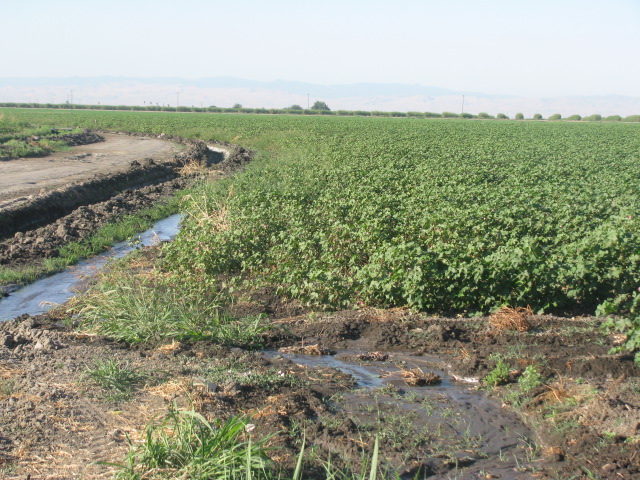
Fall is a little more than a week away. The fruit on the plants have reached maturity and new terminal growth has pretty much stopped. And many growers have put a stop on irrigation.
Cotton growers are ending irrigation for the season.

Field scout Damien Jelen says we can officially say cotton has reached cut-out – the final stage of plant growth before the bolls open.In fact, Damien did spot one field in which bolls were starting to crack open.

For cotton, cut-out takes place when plants are at three to five Nodes Above White Flower (NAWF). Cut-out means cotton bolls are mature and about 95 percent of the crop has been set. This is an important barometer for growers because cut-out provides a good indication about the cotton yield during harvest time.

“Growers were thinking we were going to have an early season. But the cool weather lately slowed things down,” Damien says, pointing to temperatures in the low 90s and high 80s at the end of August. “Cotton likes the heat.”

As a result, Damien says, cotton gins are preparing for a normal harvest season in October and early November in some cases.

Lygus bugs are no longer a threat to cotton.
Meanwhile on the pest front, lygus is no longer a threat. Normally, growers stop monitoring for lygus about 10 days after cut-out. Their attention now turns to aphids and whitefly, which can lead to sticky cotton.

So far, the good news is aphids and whitefly are under control. “The counts are all down,” Damien says about his pest findings during his sweeps in the cotton fields.
  
In alfalfa, growers have wrapped up another harvest and are irrigating their fields again. Many will continue cutting through October – with a few trying to squeeze in another harvest in November, depending on the weather.