Monday, May 27, 2013

Let’s Talk Ants, Almonds and Colonization in the Orchard


You remember last week when Jenna mentioned spotting lots of ants parading around some almond orchard floors during her scouting rounds in the Valley.

Now is the time to monitor for ants in the almond orchard.
Well, this is the prime time for growers to head into their orchards, put on their census bureau hats and start taking count of this pest. This is the optimum time to detect ant damage, says veteran entomologist and almond expert Walt Bentley, UC IPM emeritus. You certainly don’t want ants colonizing your orchards come summertime.

This is the damage caused by ants.
Sometimes, growers don’t even know they have an ant problem because nests could be hidden by a cover crop or other things. There are many reasons for ants to build up. Some include the trend toward drip irrigation and microsprinklers as well as drought conditions and warm winters. Ants like to live around moist conditions.

The major concern is at harvest time when almonds are shaken off the trees to dry. Ants can get into an open shell and eat at the kernel. Soft shell varieties such as Nonpareils and Fritz are the most vulnerable.
Take care of ants before tree shaking occurs.

How do you tell if you have an ant problem?

You should be looking at a 1,000 square foot area in the orchard, Walt says. “If you start getting eight or nine colonies in that 1,000 square feet then you probably need to manage the ants, particularly if you have soft shell varieties,” he tells us. The Almond Doctor – UC extension advisor David Doll of Merced County – has made available a handy UC IPM ant colony monitoring form for growers to use.

Use ant bait to control the ant populations.
Ideally, the best time to control ants is in late winter or early spring when ant nests are shallow. As the weather gets warmer, ants will burrow deeper into the ground. Ant bait is considered the preferred method to control the pests. You want to take care of the pest before harvest. Check the http://www.ipm.ucdavis.edu/PMG/r3300411.html for more information about dealing with ants.

In other observations, Walt points out some almond growers may have been lax in orchard sanitation this past year. Walt’s a vocal advocate for getting rid of mummy nuts during the winter to avoid problems with navel orangeworm.  “We had a couple of good years where the navel orangeworm was very low.  Because of that, you can get a little complacent.” The result, Walt says, is “you may see a bit of an uptick in navel orangeworm this season.”

Field Day Alert: An impressive line-up of UC experts are lined up for a Cotton Field Day on Wednesday, June 5 from 10 a.m. to noon at the McCurdy Farm on Highway 33 in Firebaugh. Go to the Sustainable Cotton Project website for directions. The speakers are: Dr. Pete Goodell for a cotton pest management update; Steve Wright of UCCE in Tulare on herbicide resistance; Dan Munk of UCCE Fresno on cotton production risks in low water years; and UC cotton extension specialist Dr. Bob Hutmacher. Tell a friend and neighbor.


Monday, May 20, 2013

Valley Alfalfa Growers: Building a Natural Habitat for Bugs


We all know about Habitat for Humanity – the charity that gathers community members to build homes for the less fortunate.

Did you know San Joaquin Valley alfalfa growers boast their own version? Call it Habitat for Entomology. Yes, these growers “build” homes for a diversity of good bugs and crop-damaging pests.

Leaving a strip of uncut alfalfa  can keep pests out of nearby cotton fields.
Of course, we’re not talking about brick and mortar or hammer and nail type of homes. We’re looking speaking of 8- to 12-feet wide, hundreds of feet long swaths of fresh alfalfa.

In farmer parlance, it’s called strip cutting. And this time of year, we’re joining University of California extension advisors in spreading the word to alfalfa growers to start making plans for leaving uncut strips of alfalfa as habit to attract natural predators as well as pests, including the dreaded lygus.
Alfalfa harvesting disrupts  the homes for pests.

Dr. Pete Goodell, a UC Integrated Pest Management advisor and cotton expert, says the first fruit, or square, on the young cotton plants are starting to emerge. Pests living in the alfalfa fields will flee to nearby cotton fields as the crop is cut and harvested.

Let’s put it another way. If you lose your home to fire or an earthquake, the first thing you do is find another house to live in. Well, that’s the same thing pests such as mites and lygus do when their home – i.e. alfalfa field – is cut down every few weeks through the fall. Mites and lygus – which are rather fond of alfalfa – are troublesome pests to cotton. (Check out Dr. Goodell’s blog for more information about lygus.)

So we remind alfalfa growers to leave a “home,” or strips of uncut alfalfa as a habitat to attract natural predators such as green lacewings and parasitic bugs and provide a place for lygus to stay until the alfalfa grows back. Right now, growers are in their second cutting of the season for alfalfa. They haven’t been leaving strips so far – some may figure pests fleeing the alfalfa haven’t been a threat yet to cotton.
Some cotton plants have developed the first square.
- Photo by Mississippi State extension

But field scout Carlos Silva and Dr. Goodell visited some cotton fields last week and found most plants were at five to six nodes and a few even have developed the first square, which signals the plant is entering an important growing stage that ultimately determines yield potential. The young plants are looking good and are about five to six inches tall.
Young cotton plans are developing nicely in the Valley.
As growers move into the second cutting of alfalfa, Carlos reports no significant pest issues at the moment. Alfalfa aphids have pretty much gone away. Some have weevils. He’ll starting looking for other pests soon such as beet armyworms.

Almond field scout Jenna Horine says she has found some orchard locations with nuts damaged by leaffooted bugs. As we mentioned previously, leaffooted and green stick bugs will leave a gummy substance on the outside of the nuts. But day-night temperature swings can affect nuts and result in similar gumming as well. To determine pest damage, you have to cut the nut in half.

Jenna says the pest damage is rather spotty and doesn’t appear to be a major problem overall. Check out UC IPM online to learn about controls for the leaffooted bug.

Irrigation could be affecting ant colonies.
  In the meantime, Jenna reports a rather large number of ants crawling around orchard floors. This is the time for growers to check their orchards for ant colonies to determine if there is a need for treatment. It’s best to tackle ant problems now to limit damage and crop loss after shaking this summer. In the northern San Joaquin Valley, growers should survey for ants two to three days after irrigation around this time and in June. You can learn more about monitoring and treatment decisions for ants from UC IPM.


Monday, May 13, 2013

Nothing Cliché about Judging the Almond Pest Threat


Oftentimes old sayings seem trite – like “All’s well that ends well” or “Money doesn’t grow on trees.”

On occasion, though, one fits perfectly. Take “You can’t judge a book by its cover.” Then take a good look at this almond:

Gumming coming out of this almond looks like tree sap.
Judging by the cover (in this case the green outer shell), the gumming on this nut could be could be a sign of leaffooted bug damage. Here’s what UC Integrated Pest Management says:  “Feeding by adult leaffooted bugs on young nuts before the shell hardens … may cause the nut to gum internally, resulting in a bump or gumming on the shell.”

Leaffooted bug damage inside an almond.
Around the Kerman area west of Fresno, growers have seen similar gumming on outside of the young nuts. But uncover the inside and there aren’t signs of damage by leaffooted bugs.

What’s the story? In checking with almond expert Walt Bentley, UC IPM emeritus, the sapping is probably due to wide temperature variations with high temperatures in the 90s and nighttime lows in the 50s. That can cause the oozing. So you can’t judge a nut by its cover. Feel free to check in with our  almond scout Jenna Horine if you have questions about your nuts. She can put you in contact with Walt Bentley if it likes like there is a problem.
Here's close-up of the leaffooted bug.

Almond growers are happy that the gusty winds we’ve been having finally died down. Many have been holding off treatments so they don’t have to worry about spray drift.

In the cotton fields, the young plants are in the three to fifth node. The crop looks good with no pest threats at this time. But growers still need to monitor for spider mites and thrips.


Alfalfa growers should start planning to leave strip cuts.

This week, alfalfa growers should be in the second harvest of the season. Aphid counts are low. That’s good. Soon, we’ll be reminding growers about strip cutting to provide a habitat for pests and keep them out of neighboring cotton fields. That’s our Good Neighbor policy.


Monday, May 6, 2013

Growers Feel Blue over Aphid Damage, Loss of Greenbacks


Farmers can certainly get worked up when talk turns to bugs and bucks.

This certainly was the case last Friday while attending an alfalfa field day in Dos Palos last Friday led by Dr. Pete Goodell of UC Integrated Pest Management and UC Extension entomologist Larry Godfrey.

The pea aphid can be mistaken for the blue alfalfa aphid.
- Photo by Kansas State University
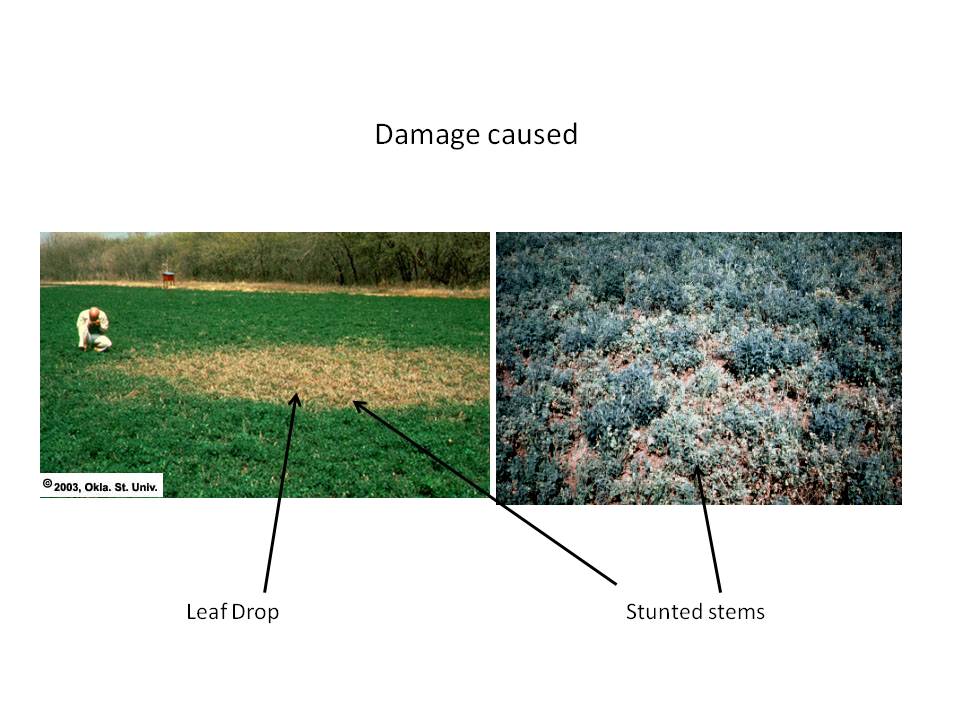
The buzz among alfalfa growers in the Central Valley this season has centered on the pesky blue alfalfa aphid, which feed on alfalfa stems and can lead to wilting and stunted growth. These deep green-blue invasive bugs – which can be confused with the pea aphid – were particularly troublesome this spring.

Indeed, Pete and our alfalfa-cotton field scout Carlos Silva saw the problem first hand while touring local alfalfa fields recently. This field looked like the alfalfa had just been cut for the first time this season. The only problem: the first cutting came about a month earlier. That spells revenue loss.

Here are examples of damage by the blue alfalfa aphid.
- Photo by Oklahoma State University
According to Larry, the blue alfalfa aphid was first found in alfalfa near Bakersfield in 1974. The following year, this invasive pest from eastern and southwester Asia was discovered throughout Southern California. Today, this aphid can be found as far east as Kansas and Oklahoma.

In the San Joaquin Valley, pest control advisors indicated during the field day that treatments weren’t totally effective this spring. So far, there are no definitive answers to the treatment issue or the root of the blue alfalfa aphid outbreak.

On the bright side, Carlos says he has recorded low counts of blue alfalfa aphids during his field sweeps. The spate of hot weather could be an ally for the rest of this year. These pests thrive in 60 degree weather. When the thermometer reaches 75 to 80 degrees the blue alfalfa aphid population decreases quickly. That’s one good thing about these 90-degree days. Although temperatures dipped into the high 70s the past few days, weather forecasts say the weather should quickly head back into the 80s. We can probably say wait till next year for these aphids.

In the meantime, growers are poised to do the second alfalfa cutting of the season. One farmer, in fact, already wrapped up his second harvest.

On the cotton front, the young plants are basking in the hot sunshine and growing rapidly.  Cotton stand development is good. The seedlings are growing nicely with some plants reaching first true leaf, which is the time the plants start developing squares.
Spider mites are pests to cotton.
- Photos by UC IPM


Watch for the western flower thrip.


Growers should monitor for whiteflies.

Cotton growers need to keep an eye out on thrips, spider mites and whiteflies.  So far, there are no major pest problems to be worried about at this time.  Keeping check back here for field updates throughout the season.


Monday, April 29, 2013

Eagerly Waiting for Cotton to Emerge from the Ground


These are both eager and anxious times for cotton growers.

Cotton seedlings emerge from ground.
First, they are eager to see how their newly planted cotton emerges from the fertile Valley ground. Then they get anxious as they wait for the cotyledons to unfold just above the soil and how the young plant population is doing – or stand establishment.

Taking measurements to assess stand establishment.
At this point of the early season, farmers are starting to assess how well the stand is established in the field to determine how well the crop is growing. The University of California Integrated Pest Management says this: “By comparing the plant population per foot with the seedling rate per foot, you can determine if the stand is optimal, weak or excessive.”

The optimal stands have 30,000 to 60,000 plants per acre. A weak stand falls below that range and requires growers to look for signs of seedling diseases or insects. If there are lots of rows without plants, then growers must consider replanting.

A corn habitat is planted next to a cotton field.
On the flip side, excessive growth may require thinning the crop. A heavy plant population could make the crop vulnerable to insects and diseases. Check out UC IPM online for more information about counting the plant population and assessing stand establishment.

Cotton field scout Carlos Silva and Dr. Pete Goodell of UC IPM checked some Valley fields last week and found stand establishment to be optimal. With the late-spring hot weather, we can expect the seedlings to start taking off. The first true leaf is around the corner. Remember first true leaf is considered a significant development milestone leading to a successful cotton season.

In the meantime, Carlos reports the natural habitat of corn, buck wheat and yellow mustard planted around some of the local cotton fields are doing well. That should be good for helping keep the bad bugs out of the cotton.

The local alfalfa fields are liking the weather, too. Some growers are getting close to doing the second cutting soon. On the pest front, growers need to remain vigilant for the blue alfalfa aphids. We don’t want them to get out of hand.

Jenna Horine has been busy scouting the almond orchards for pests. Counts in peach twig borer traps have been a little high. She’s huddling with UC IPM Emeritus Walt Bentley to get an assessment on PTB. Overall, the almond crop is progressing well.

Trees are loaded with lots of almonds this season.
Could we be poised for another record-breaking year? Growers could get a jump on ensuring bumper crop on Thursday when the San Joaquin Sustainable Farming Project conducts its first Almond Field Day of the year this Thursday morning. Here are the details:

Almond Pest and Crop Management Field Day – Thursday from 10 a.m. to noon at the LPGL Ranch, 11599 W. Shaw Avenue, Fresno.  The speakers are: Entomologist Walt Bentley on “In Season Monitoring Pest Pressure and Preserving Beneficial Populations” and Almond Doctor David Doll of UCCE Merced County on “Almond Disease and Nutrient Management for the Spring and Early Summer.” There are 2 hours of continuing education credits available. Don’t miss out on getting expert advice. Feel free to bring any damaged leaves or shoots for identification by the experts. See you there.

 If you want to learn more about alfalfa, Dr. Goodell and UC Extension entomologist Larry Godfrey will lead an Alfalfa Field Day discussion about this season’s outbreak of blue alfalfa aphids in the San Joaquin Valley and other parts of the state. The event is from 11:30 a.m. to 2 p.m. on Friday at the Dale Hale Community Center,  O’Banion Park (southeast corner of Center and Lorrain Streets) in Dos Palos. The meeting will look at dealing with the pest today and in the future and how pest control advisors can help. It should be informative. Lunch is included, so come have some lunch and learn more about blue alfalfa aphids.


Monday, April 22, 2013

Summer-like Weather a Mixed Bag for Central Valley Farmers


 It’s not your imagination. It’s been a hotter than usual around the Valley. You can throw in windy, as well.

Checking Weather Service statistics, we discovered these 80-degree days (and 90 degrees today) are far from normal. Usually, we get temperatures in the 70s.

For farmers, this warm spring is a mixed blessing. We are seeing almond growth take off. Our almond field scout Jenna Horine has seen some nuts doubling in size in the past week.

Newly planted cotton fields are seeing young plants emerge quickly from the ground. This hot weather should accelerate growth and stand development. Alfalfa re-growth could take off, too.

Here’s the flip side. The high temperatures could produce ideal breeding conditions for pest populations to explode. Jenna worries that mite problems could flare up in almond orchards.

A fallen tree in the orchard interior.
Strong winds uprooted almond trees in local orchards.
With strong winds – reaching up to 37 mph  - continuing last week, we saw more spare nuts being batted around and dropping to the ground. Trees also fell to the wind. Jenna says the windy weather could have impacted the pest traps placed around in the orchards. Bugs could have hunkered down and become less active, making it difficult to get a gauge on pest counts.

One grower contacted Jenna about some of his almonds shriveling up and then falling off the trees.  It’s normal to see some nuts fail to develop and eventually drop. Despite the winds the past two weeks, there’s nothing to be alarmed about right now, according to UC IPM Emeritus Walt Bentley. Trees have been loaded with almonds.

On the alfalfa front, some growers are reporting a high level of blue alfalfa aphids in some fields. These pests inject a toxin that hampers growth, reduce yield and even threatens to kill the plant. Learn more about the blue alfalfa aphid from the UC IPM website.

Some fields are finding a high number of blue alfalfa aphids.
- Photo by Kansas State University
A grower plants cotton seeds in his field. Cotton planting is wrapping  up. 
Field scout Carlos Silva has seen beneficial insects such as the lady bugs and parasitic wasps doing their work on aphids.  You see plenty of dead aphids on the ground or alfalfa stems.

This week, we’ll be checking out cotton fields for stand establishment. So far, everything looks good.

Could this unseasonable warm weather translate into an early season?  It’s too early to predict right now. The season is still young. And Mother Nature is always fickle.  Too often, we’ve seen hot weather turn cool and rainy seemingly overnight. Remember there’s still 1 ½ months of spring left.


Monday, April 15, 2013

Heads Up: Nuts Rain Down Amid Windy Valley Weather

Winds caused almonds to drop to the ground.

 There was a whole lot of shakin’ going on in Valley last week.

If you didn’t look at the calendar you’d bet it was summertime because of all those nuts blanketing the ground. Who needs a tree shaker when you have Mother Nature bellowing out wind gusts that topped out at 39 miles an hour in some parts around here.

Take a look at the photo (above) taken by our almond field scout Jenna Horine. You can see almonds, almonds and more almonds everywhere between the rows of trees. Nut-laden branches, wiped by the wind, were banging into each other and causing nuts to fall to the ground. The National Weather Service wind gusts reached 32 mph on Sunday, April 7 and 39 mph the following day.

Older trees and those with tall canopies seemed to experience the most nut drop, Jenna reports.

While the sight of all these nuts on the ground might be cause of alarm, growers tell us they aren’t too worried. Trees always lose a percentage of nuts during the season. Last week’s drop wasn’t considered significant – i.e. – not enough to cut into yields and future revenue.

Indeed, it’s normal for nuts that stop growing to drop before reaching full size in April and May, according to the University of California Almond Production Manual. This drop is “considered a natural thinning process due to competition from many nuts.” Let’s hope the winds don’t do a lot more thinning in the future.

A small percentage of growers still do flood irrigation.
Meanwhile, some farmers are doing flood irrigation to get water deep into the ground.  Yes, there are still some growers flooding their orchards. Most almond growers, however, have converted to micro-sprinklers or drip irrigation. Recent surveys indicate 80 percent of Central Valley almond growers used drip because of its efficiency – watering and fertilizer applications are more precise.
A peach twig borer trap nabs lots of pests.

While the wind made field scouting tough last week, we can say the mites and peach twig borer appear under control in almonds. Some PTB counts were a little high in some orchards, but it isn’t enough to be worrisome.

Around the cotton fields, plantings are in full swing. After this week, most growers should have finished planting this year’s crop. Soon, we’ll be starting the countdown to harvest.

Alfalfa growers are wrapping up their first cutting of the season. The pest counts are low right now. That’s a good sign.

Alfalfa growers are wrapping up the first cut of the season.
Well, it’s safe to say things are starting to heat up for farmers – and Mother Nature, too. Yes, forecasters predict we’ll see our first 90-dgree temperatures of the year by early next week. Pack
the sunscreen, hat and bottles of water.