Monday, November 20, 2017

Almond Crackout More Than a Shell Game for Growers


We’re all familiar with the shell game.

You shuffle the shells and guess where the hidden pea is.
Well, field scout Jenna Mayfield offers her own version of the shell game. Call it the almond shelling game – an annual event that takes place every fall after the almond harvest.

Harvest samples are taken after nuts are shaken to the ground.
Among industry and academic research circles, Jenna’s version is better known as crackout. The University of California Integrated Pest Management program calls the practice a cost-effective way to manage pests for the coming season.
Before we get into more detail about pest management, let’s start at the beginning in which growerscollect samples from various locations in the orchard during the harvest.

Jenna picks up samples for about two dozen growers. She collects nuts shaken from trees in three separate areas in an orchard where pest traps were placed. Jenna gathers about 200 nuts from each variety planted in the orchard. Growers will plant different almond varieties in every orchard. If there are three varieties in the orchard, then Jenna will pick up a total of 600 nuts in all.

Cracking the nuts and inspecting each one helps confirm what she discovered in the orchards during scouting this season, Jenna says. 

Jenna inspects each kernel, writes down her findings from every orchard and provides a report to every grower. The findings indicate how well the grower’s pest management practices fared during the season. Growers also can compare the results to a grade sheet received from the huller.
The practice gets positive reviews from UC extension advisors.

Almond pest damage could be hidden by sweeping.
Merced County’s UC Cooperative extension advisor and pomologist David Doll wrote in a 2010 Almond Doctor column: Crackout should be done because damage is hidden by the handling that occurs during sweeping, pickup, and processing. In some cases, we have found 4 percent more

damage in harvest samples than what was indicated in the grower’s processor report.  In other words, when we found an estimated 5 percent damage/reject level in the harvest sample, the processor indicated a 1 percent rejection level. The 4 percent discrepency is most likely due to damaged nuts lost during the steps of harvest.”

He goes on to say that a harvest sample accounts for damage that does occur in the field. “Often times processors lump all worm damage together, not separating out NOW (navel orangeworm), PTB (peach twig borers) or other worms. Ant damage often does not show up because the chewed out pellicles are blown out the back of the pick-up machine. Gummy nuts due to deficiencies, feeding, or other conditions are all lumped together.”

Jenna adds that nut sampling is a good way to identity past pest damage and predict potential future damage. Moreover, experts say crackout prevents growers from making the wrong assumptions about pests.


Monday, November 13, 2017

A Dull Year in the Cotton Field – That’s Bright News for Growers Across the Valley


It’s hard to believe another cotton season is winding down.

Way back at the end of March, we found a few early-bird growers getting a jump by planting the first cotton seeds in the ground. For the first time in five years, growers came into the season feeling more optimistic.

California cotton acreage increased this year.
As we all remember, the severe drought coupled by little to no federal water allocations for many Westside farmers during the 2010s cast a pall over California cotton production. But a drought-busting winter seemed to rejuvenate growers – thanks to loosened water allocations.

The statistics tell the story. This year, growers are predicted to harvest 90,000 acres of upland/acala cotton (up from 62,000 acres in 2016) and 208,000 acres of high quality Pima (up from 191,000 acres in 2016), according the United States Department of Agriculture’s National Agriculture Statistics Service.

In early May, young cotton plants started emerging from the ground during unusually warm spring days.  Growers started to irrigate for the first time after planting.
Of course, there are always bumps along the way. Growers continued to deal with the presence of Fusarium wilt in their fields. The most trouble is Race 4 Fursarium, a nasty soil disease that moves within fields through the soil or water. It also survives indefinitely in the soil.
A wet winter meant greater water availability in 2017.
Looking back, field scout Damien Jelen says “we had a pretty heavy bug problem this year. We didn’t really get a freeze to knock down the bug pressure.”

Yes, a mid-June heat wave added to the pest pressure. Then in August the cotton aphid population suddenly exploded and forced growers to take quick action on treatment.

Despite the bug issues throughout the season, growers were able to knock back the pest threat effectively and “didn’t lose too much crop – nothing out of the ordinary,” Damien says.

Growers dealt with a heavy bug problem this season.
As usual, aphids and whitefly were worrisome after the bolls started to crack open and the fluffy lint started to pop outin late summer. The honeydew triggered by these pests can lead to sticky cotton and downgrade fiber quality.
  
The good news:  “We didn’t have any real problem with sticky cotton,” Damien says.
You might say the cotton season was absence of any real drama in the field. That’s how we like it.


Monday, November 6, 2017

Cleaning Cotton Takes a Lot of Hot Air at the Gin


 Imagine needing to take a shower 10 times before you become squeaky clean.


Cotton going through a dryer at the gin.

Imagine your heart surgeon needing to scrub her hands 10 times before she’s ready to operate.
Or imagine needing to wash your new car 10 times before it regains its luster.

Well Matt Toste can imagine such a tedious cleaning process with freshly harvested cotton. Believe it or not, cotton needs to be cleaned 10 times before its ready to be pressed into a 500-pound bale and then ready to be shipped to the warehouse.

Here’s something even more impressive: The 10 cleanings take only 45 seconds from start to finish. (That’s like taking those quickie showers during the height of our drought a couple years ago.)
Cotton from a module being broken up before entering gin.
“It’s moving. Every time a piece of cotton hits the machinery we’re cleaning it. We’re cleaning, cleaning and cleaning,” says Matt, manager of the Westside Farmers Co-op Gin in the Firebaugh area of Fresno County.

Certainly Eli Whitney would be impressed. You may recall Whitney invented the cotton gin in the 1790s, the first mechanical process to remove seeds from cotton. The cotton gin is considered one of key inventions that triggered the industrial revolution in the South.

Before the gin, seed removal was quite labor intensive. Whitney’s gin – which is short for engine – could process about 55 pounds of cotton in a day. Imagine that.

Inside the gin operation.
First, let’s step back and explain why and how cotton is ginned.

Cotton fiber, or lint, is produced in seed pods on the cotton plant. Seeds, which are interspersed with the fiber, must be removed from the lint. Other things such as leaves– called trash by the industry – must be removed so that the cotton comes out clean and ready to be pressed into a bale. The cotton bales then go to a spinning mill to produce yarn or cloth.

In the past, we talked about the how cotton is picked by a harvester and the fiber is compressed into large rectangular or round modules, depending on the harvesting rig. A round module contains enough cotton to produce 4 to 7 bales, depending on the brand of harvester. A conventional rectangular module is bigger than the round one and contains enough fiber to produce almost 18 bales. Picking rigs that produces round bales require fewer employees in the harvesting process.

Here’s what happens after the modules arrive from the field. The modules are loaded onto a feeder to break apart the compressed fiber. The cotton then is fed into a heated dryer to take out excess moisture and moves into a series of cleaners.

Cleaned cotton pressed into a 500-pound bale.
“What the heat does is it loosens up the trash in the cotton,” Matt says. Air pumped through the cleaners keep the cotton bouncing around to separate the small leaves and other trash from the lint as well as move the cotton from cleaner to cleaner. 

“Air is very crucial in the gin to make it run very efficiently and get the trash out,” Matt says. After going through a sixth cleaner, the seed is then separated and sent to a conveyor belt, which sends the trash and seed to large mounds outside the gin.

Cotton seed is put into a mound outside the gin.
The seed is sold as feed for dairy cows. At the same time, the fluffy trash of small leavesis piled high outside the gin and is sold for mulch. To produce one 500-pound bale, the gin has to remove about 800 pounds of seed and 200 pounds of trash.

Cotton bales ready to be taken to a warehouse.
During the ginning process, two small bags of lint samples are pulled from the production line. One sample is sent to the U.S. Department of Agriculture and the other heads to a cotton warehouse selected by a grower.The USDA will analyze the samples and classify the lint according to color, length and strength and absence of trash. The other sample is used by the cotton marketer to demonstrate the properties and quality of the fiber to prospective buyers.

For the most part, Matt says, “We have premium cotton going out.”


Monday, October 30, 2017

In a snapshot and a snapshot and another snapshot … Cotton Farm Tour Visitors Capture the Moment


 “A picture is worth a thousand words.”

 While this idiom expressing a single photograph can explain a complex idea may be a cliché, the phrase is quite apt to the October 24 Cotton Tour in the northern San Joaquin Valley.

Let’s take it even further: If one photo is worth a thousand words, then thousands of photos are worth a small fortune.

Indeed, the 55 tour participants riding in a comfortable charter coach bus resembled a gathering of paparazzi instead of fashion industry representatives.

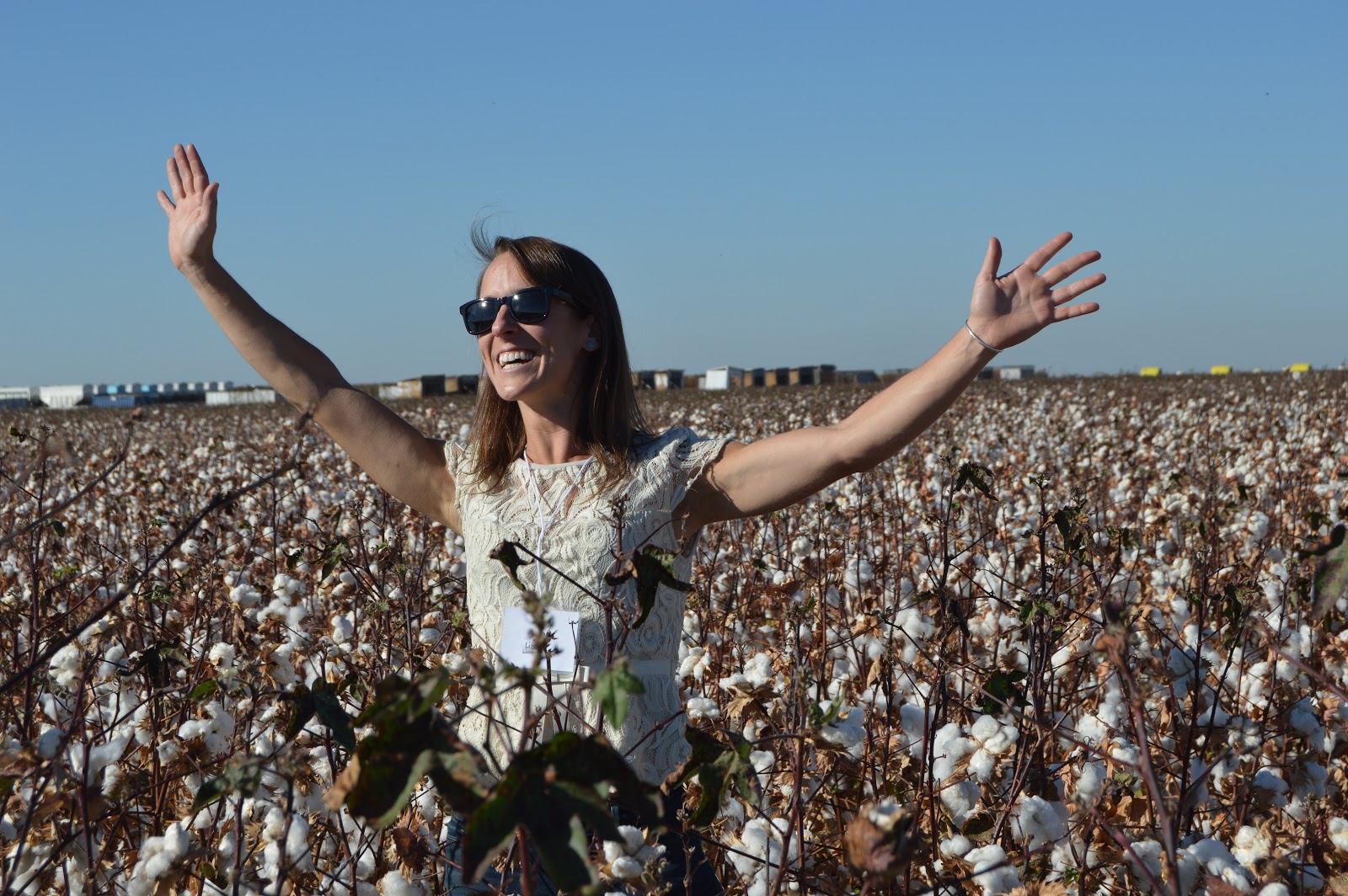
 At every stop during the Sustainable Cotton Project’s annual event, men and women alike pulled out smart phones, digital cameras and video recorders to capture every moment during the day-long event that explored every aspect of California cotton production. In a snap, they probably shot thousands of photos of cotton, more cotton and even more cotton. Get the picture: Cotton was the paparazzi-like celebrity of the day.

A healthy, green rosemary plant growing in a newly planted perennial hedgerow: Snap, snap

Brown colored cotton bursting out of a boll: Snap, snap.

Windfall Farms co-owner Frank Williams standing among his colored cotton plants, explaining water issues, cotton production and anything farming: Snap, snap.

Dr. Pete Goodell, University of California Integrated Pest Management extension advisor emeritus, describing the qualities of cotton fiber: Snap, snap.

Tour participants getting a rare chance to walk among mature cotton plants, hand-pick the fluffy fiber and even feel the sticky honeydew residue on plant leaves – a condition created by whiteflies:  Snap, snap.

Westside Farmers Co-op Gin manager Matt Toste describing how modules of freshly harvested cotton are transported from the field and processed inside the bustling, noisy gin, adding it takes just 45 seconds from start to finish for the seed and trash to be separated from the fiber and compressed into 500-pound bales that shrink-wrapped and loaded onto flat bed trailers: Snap, snap.

Visitors strolling through the gin, feeling a heated fiber, inspecting the machinery and control boards and watching bales being formed: Snap, snap.


Fashion industry representatives smiling and clutching an armload of just-picked cotton before the fiber heads into the gin for processing: Snap, snap.


Tour participants walking outside the gin, inspecting the pile of separated cotton seeds used for livestock feed.

Cleaner Cotton farmer Dan McCurdy talking about cotton production and the harvest,  describing how his new harvester picks the fiber and creates the round modules stored alongside the fields for transport to the gin: Snap, snap.


“I’ve never seen a cotton farm. It was really interesting,” said Anna Rotty of Williams Sonoma in San Francisco. It was a first for most of the visitors, who closed out the tour with a few light-hearted Kodak moments: Snap, snap.


 Closing out the day: “It was fascinating,” Merrilee Avila of Nike said before she and her colleagues headed back to Portland, Oregon. She then paused and added: “I learned my job depends on agriculture.”